The QueensLink Story
Why a 3.5-mile corridor through Queens has become the center of a debate about transit equity, urban design, and who the city serves.
While you're reading this, $38,841,439 in public benefit could have been realized had we built QueensLink.
See live calculations →Chapter One
Queens as a Transit Desert
The most populous borough outside Manhattan has the fewest subway stations per capita in New York City.
Subway stations per resident
Queens residents endure the longest average commutes in the country. There is no direct subway connecting Northern and Southern Queens.
Chapter Two
The Abandoned Right-of-Way
Queens has no direct subway connection between its northern and southern neighborhoods. A trip from Forest Hills to the Rockaways, two parts of the same borough, requires going through Manhattan and back.
But there is an existing solution. A right-of-way is a strip of land legally reserved for transportation use. The City has owned one running 3.5 miles through the heart of Queens since the LIRR Rockaway Beach Branch last ran revenue service on
June 9, 1962.
The Rockaway Beach Branch in context
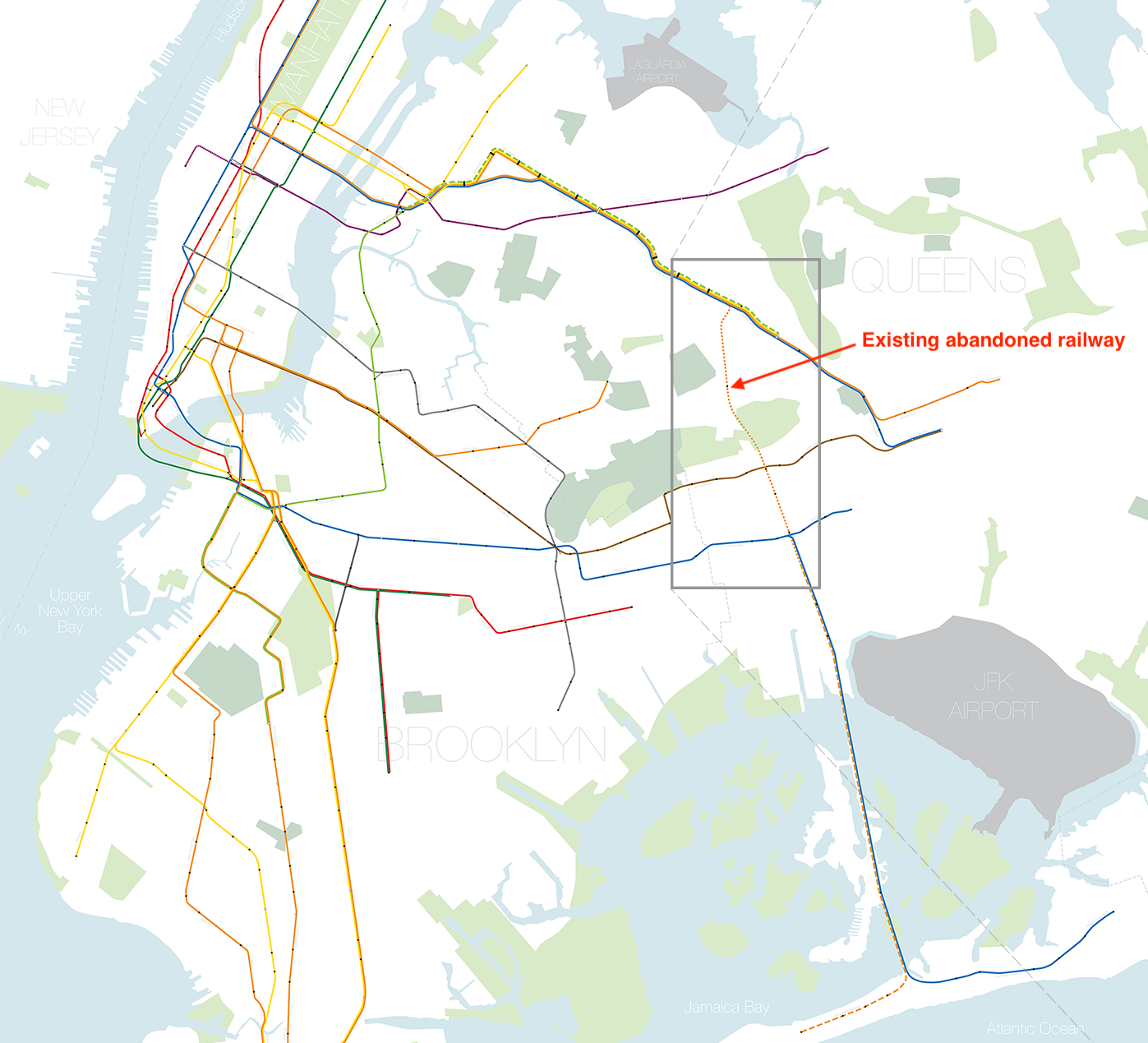
Map: Andrew Lynch / vanshnookenraggen.com
For 64 years, the City has retained this right-of-way with much of the original railway infrastructure remaining in place. It runs 3.5 miles through the heart of Queens. The question is what to build on it.
The dormant corridor could potentially connect existing subway infrastructure at three points: the M/R at Rego Park, the J/Z at Woodhaven Boulevard, and the A train to the Rockaways.
However, there are plans in motion called QueensWay to build a park strip that removes the dormant track infrastructure in favor of a linear park in the style of the High Line.
In contrast, QueensLink calls to reactivate the existing railway infrastructure and connect a north–south corridor for the subway.
Chapter Three
What Are the Options
QueensLink
A rails-and-trails approach: subway service through the corridor with a 33-acre linear park alongside.
QueensWay
A park-only design inspired by the High Line: the entire right-of-way converted to green space.
Both proposals address the corridor. QueensLink is complementary to the proposed IBX, which serves different geography connecting Brooklyn and Queens via existing freight right-of-way.
Chapter Four
Who Lives Here
2 in 5
Queens residents (880,000 people) live within walking distance of the corridor QueensLink would serve.
Source: Steer IBC §2.3
Households without a car — Queens Boulevard corridor
For more than half of residents along this corridor, transit is not a convenience: it is the ONLY option.
Source: Steer IBC Table 2.2
Low-income household rate
These are the households least able to absorb the cost of car ownership. Without viable transit, there is no alternative.
Source: Steer IBC Table 2.2
Northern Elmhurst to the Rockaways
68
minutes today
42
minutes with QueensLink
A trip from Northern Elmhurst to the Rockaways takes 68 minutes by transit today. With QueensLink, it would take 42 minutes. A resident who cannot reach a job, a hospital, or a school in a reasonable time because the same journey takes over an hour faces a barrier that does not appear in any budget line. The difference is not convenience — it is access to opportunity.
Source: Steer IBC Figure 4.2, p.41
Chapter Five
Where Is the City Going
Adams administration
- $35M allocated for QueensWay Phase 1 (September 2022)
- $117M federal Reconnecting Communities grant secured (March 2024) — rescinded July 2025 under the One Big Beautiful Bill Act
NYC Backfill
- $14M city capital allocated to replace federal funding (FY26 September Capital Commitment Plan, October 2025)
Mamdani administration
- $43M in preliminary FY27 budget for QueensWay Metropolitan Hub (March 2026, subject to Council negotiation)
QueensLink
- $400K federal DOT planning grant + $100K NY State match (Assemblywoman Stacey Pheffer Amato)
- Initial Business Case self-funded via GoFundMe (March 2026, Steer Group)
Total public funding committed/proposed
QueensWay total reflects $117M federal grant rescission.
The City has committed or proposed approximately $92M to the park-only design. The rails-and-trails alternative received a modest planning grant. A $117M federal grant for QueensWay was rescinded in July 2025 — a pivot point that was not taken.
Sources: Crain's NY, 29 July 2025; Queens Daily Eagle, 8 October 2025; 21 July 2025; NY State Assembly press release
Chapter Six
The Implications
74,600
Daily riders (2040)
969K
Person-minutes daily time savings
1.10
Benefit-Cost Ratio, Core Scenario
Economic Analysis
$6.78B
Total societal benefit
1.10
Benefit-cost ratio
$600M
Net present value
Net present value: $600 million. Evaluation period: 2035–2065, discounted at 3.0% in 2025 dollars.
According to the Steer Group Initial Business Case, QueensLink generates $1.10 in societal benefit for every dollar of lifecycle cost — capital, operations, and maintenance over 30 years.
Source: Steer IBC §11.1, Figure 11.1
Chapter Seven
A Pattern New York Has Seen Before
Infrastructure encodes political choices into the physical city for generations. New York has been here before.
Once built, it stays built
When Robert Moses chose the route for the Cross Bronx Expressway in 1955, he rejected an alternative that would have caused significantly less displacement. Once constructed, the expressway permanently altered the Bronx — not because future mayors agreed with the decision, but because the cost of undoing it exceeded the cost of living with it. The decision was encoded in concrete.
The principle applies to any irreversible infrastructure choice. QueensLink supporters argue the Metropolitan Hub, as designed, occupies the primary staging ground for any future RBB reactivation. The Metropolitan Avenue station site sits at the heart of the corridor's planned construction sequence. A Streetsblog NYC feature in May 2026 examined comparable projects in Maryland and Atlanta where rail-trail conversions significantly complicated subsequent transit construction.
Sources: Robert Caro, The Power Broker (1974); Streetsblog NYC, 12 May 2026; QueensLink spokesperson Noelle Hunter, quoted in Streetsblog NYC, 12 May 2026
Who bears the cost
The communities adjacent to the Metropolitan Hub, Forest Hills and Rego Park, have above-median household incomes and above-average car ownership. They gain a park. The communities QueensLink would most directly serve, the new station catchment and the Rockaways, have higher rates of low income and lower car ownership. They gain transit access, or they don't.
This is not a claim about intent. It is an observation about distribution. The park primarily benefits those who need it least for mobility. The subway primarily benefits those who have no alternative.
Communities adjacent to the Metropolitan Hub
- •Forest Hills / Rego Park: above Queens median household income
- •Car ownership: above Queens average
- •Existing subway access: E, F, M, R within walking distance
Communities QueensLink would serve
- •New station catchment: 11% low-income households
- •Rockaway catchment: 18% low-income (vs 13% Queens average, 17% NYC average)
- •Queens Boulevard corridor: 56% of households have no car
Source: Steer IBC Table 2.2, p.16; US Census Bureau ACS 2023
The contested question
The city's position has been that QueensWay would not preclude future transit. Then-Deputy Mayor Meera Joshi (under Adams, retained by Mamdani) stated that building QueensWay would not preclude building QueensLink.
Streetsblog noted: "the city's most recent designs of the Metropolitan Hub show the park pretty firmly entrenched in areas that the train project would have to subsume."
QueensLink spokesperson Noelle Hunter, quoted in Streetsblog NYC (12 May 2026): the Metro Hub location is "the winch point of the project. It involves the Metropolitan Avenue Station, and we've identified it the primary staging grounds for construction."
Sources: Streetsblog NYC, 25 March 2026; Streetsblog NYC, 12 May 2026
The asymmetry of reversal
A subway can coexist with a linear park — QueensLink's own proposal includes a 33-acre park alongside the rail. A park built on the rail alignment, however, creates a constituency, a maintenance obligation, and a demolition cost that did not exist before.
This is not a claim that foreclosure is certain. It is an observation that the two options are not symmetrically reversible. Building transit first preserves the option of a park. Building a park first raises the cost of transit.
Sources: Steer IBC Exec Summary, p.8 (33-acre linear park); Streetsblog NYC, 12 May 2026 (Maryland Purple Line, Atlanta Beltline comparisons)
The window that closes
In 1985, a proposed Lower Manhattan highway called Westway was defeated in federal court after years of advocacy — before construction began. The $1.7 billion in federal highway funds was redirected to the MTA, funding transit improvements that still benefit New York today. Westway could be stopped because no concrete had been poured.
The Metropolitan Hub is scheduled to break ground in 2026. QueensLink supporters identify the Metropolitan Avenue station site as the corridor's critical constraint point. Once construction begins, the structural cost of reversing course — financial, political, logistical — compounds in the same way it did after the Cross Bronx Expressway was poured. The window does not stay open indefinitely.
Sources: Federal Highway Administration, Westway project records; Streetsblog NYC, 12 May 2026; QueensLink spokesperson Noelle Hunter, quoted in Streetsblog NYC, 12 May 2026
Chapter Eight
How to Help
Contact Officials
Reach out to your City Council members and the Mayor's office.
Let them know transit equity matters to you.
Ask about QueensLink funding in the City budget.
Share
Spread the word about the corridor and the opportunity it represents.
Talk to neighbors. Share this page. Make the case.
The corridor has waited 64 years. The decision about what to build will shape Queens for the next century.